ODOT Claims it has funding to widen I-5 through Eliot, but it still has roadblocks in its path

This month, ODOT issued a press release claiming the agency intends to start construction in the summer of 2025 on the proposed Rose Quarter Freeway Expansion Project despite ODOT only possessing 40% of the needed funding for the entire project and numerous legal hurdles in their way.  The press release is designed to give this project as currently designed an air of inevitability, with ODOT issuing statements like “The I-5 Rose Quarter Improvement Project was created by the local community, City of Portland and ODOT working together to plan for changes coming in the future of inner north and northeast Portland. By building new separated bike lanes and wider sidewalks, improving the highway and creating new roadway connections, the project will create a better connected community, a more reliable I-5 and support economic growth.” (ODOT press release, 2018).

In a presentation to the Oregon Transportation Commission (OTC) this month, ODOT admitted that with their current available funding, they are limiting the scope of the project. Their ‘phase one’ would be minimal changes from the current I-5 travel patterns, but they would almost entirely to double the width of I-5. They hope additional funding arrives from the 2025 legislature to build the community components desired by the Eliot Neighborhood and others, but there is no guarantee that funding for these elements will be delivered any time soon (or ever).
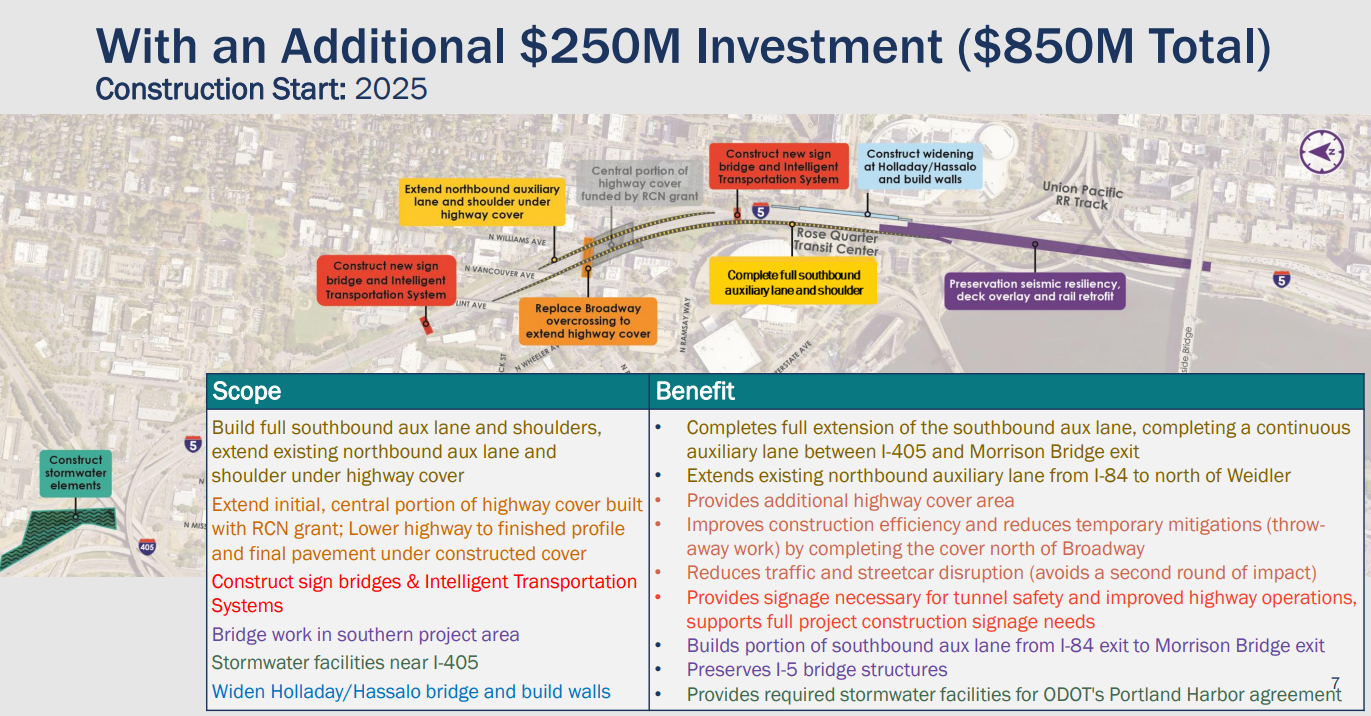
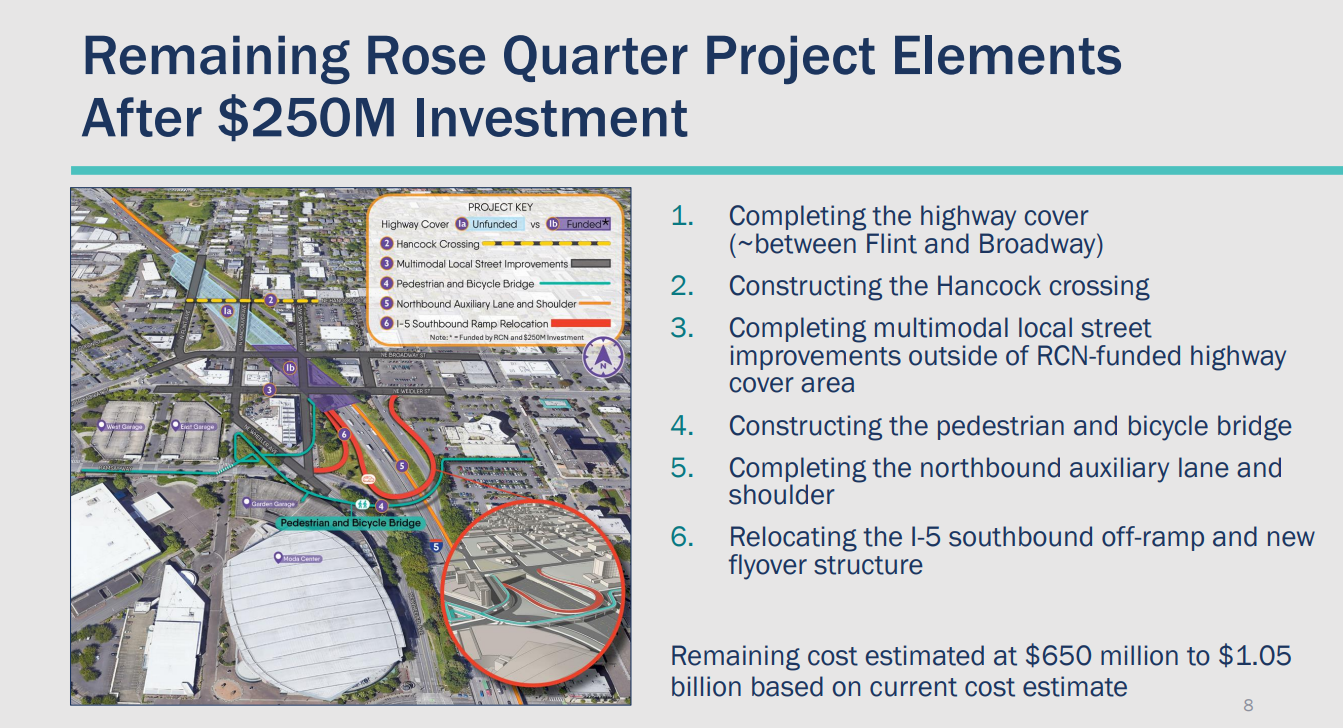
Let’s be clear – thanks to the advocacy of Albina Vision Trust and other local partners to win a historic $450 million grant from the federal government, ODOT already has enough funding to build the caps over the freeway without the expansion. But ODOT is cynically spending this money upfront on their freeway expansion plans with the intent to beg for an additional influx of hundreds of millions of dollars in the upcoming 2025 legislative session, a tall order considering the legislature’s need to prioritize finding billions of new dollars of revenue to invest in basic maintenance and preservation of ODOT’s existing deteriorating roads statewide. This prioritization of investment in freeway capacity over the highway caps at a time in which the state legislature is clearly not capable of promising this additional influx of revenue jeopardizes the likelihood our neighborhood receives the positive transformative changes we were promised. We will, however, get the years of construction impacts of this project, the increased vehicle emissions, and the additional cars on our streets making the neighborhood more hostile to local residents for years to come.

In my testimony to the OTC this month, I reminded the Commission that the Eliot Neighborhood has consistently asked for a few basic things in this project:
– Change traffic patterns to help businesses thrive
– Reduce car traffic on local streets
– Improve transit
– Reconnect the urban fabric around the area
– See usable pedestrian-scale buildings in and around the project area
– Have walkable and bikeable routes to cross the highway without interacting with cars
– Reduce air pollution

Meanwhile, the funded project will:

  • Widen I-5 south of the Rose Quarter
  • Ignore all ramp reconfigurations the community asked for and keep the status quo
  • Remove the hancock overcrossing
  • Remove the clackamas overcrossing
  • Keep the overbuilt freeway cap width, leading to the need to lower the roadbed and cause major disruptions to traffic
  • Remove the most desirable building locations from the caps
  • Widen I-5 north of the rose quarter
  • Widen I-5 in both directions through the rose quarter

The Eliot Neighborhood Association has therefore continued to serve as co-plaintiffs on multiple state and federal level lawsuits to stop this project as currently designed. We, along with advocates from No More Freeways and other groups believe that ODOT didn’t fully comply with federal environmental law that demands they look at alternatives to freeway expansion in our neighborhood.

Even if ODOT hosts a ceremonial “groundbreaking” ceremony next year to commence construction, the agency still faces numerous financial and legal hurdles to completing this project, and the Eliot Neighborhood will continue to use the tools at our disposal to demand that ODOT deliver a project that in line with our communities needs and values. Any Eliot resident who wishes to get more involved with opportunities to talk to our elected officials and legislators should reach out to me at lutcchair@eliotneighborhood.org; the upcoming year represents a critical opportunity for us to organize and stand up for our neighborhood, and we’ll need all the help we can get. 

This isn’t over, but ODOT wants you to believe that it is.

Letter from the LUTC Chair

This has been an interesting fall for the Land Use and Transportation Committee. Lots of neighborhood developments have been presented to us along with some pretty dramatic policy changes on the horizon.

In the neighborhood, we’ve seen small scale housing developments being proposed on the southern part of Vancouver and on MLK, discussed doing a street vacancy in lower Albina where Earthquake Tech has a new property on a dead end street with room for some creative use of space, heard updates on the Emanuel hospital’s renovation plans, and followed the developments on the Lloyd-to-Woodlawn greenway. I’m excited to see much-needed housing coming to the neighborhood and start to see empty lots being developed. On the Lloyd-to-Woodlawn greenway, while the changes won’t be exactly what we hoped to see, they’ll be a step in the right direction for making it safer for everyone to get around.

The proposed housing changes coming before City Council soon will also be a great step forward for improving housing choices for Portlanders and would-be-Portlanders. Better Housing by Design, the Residential Infill Project, and the associated antidisplacement measures will help make it easier to build “Missing Middle” housing – often the most affordable type of housing – and help to minimize displacement. I’m thankful to be seeing the city pushing for policies that will help make housing in Portland more affordable for more people.

How to Research Your Home and Understand Portland’s Built Environment

By Abby Morgan

As we see Portland change before our eyes, there is a number of proactive ways to invest in learning about and understanding the historic built environment through archives and community events this summer. Do you live or work in a historic property and want to know more about it? The opportunities to investigate are boundless, but below are just a couple of ways to get started. 

National Register of Historic Places

A free resource offered and operated by the National Park Service since 1966, The National Register of Historic Places is a national program that recognizes districts, sites, structures and buildings of historical significance. Homes listed on the NRHP can be designated for many reasons including architectural design. Their digital archives are available for viewing, for free, online. Is your home listed on the NRHP? If the previous owner took the steps to list your property on the register, then you are already off to a great start with your research. All you will need to do is search your property address in their index. Each historic designation is accompanied by a nomination form that dives into the property’s history. 

Not on the register but have a solid case to nominate your home? Start the process with NRHP or contact the City of Portland’s Planning and Sustainability Office about additional steps: 503-823-7700.

Oregon Historical Society- Address: 1200 SW Park Ave., Portland, OR 97205

Context will help your search. Cast a wide net by looking into census data, land and property records, et cetera before narrowing in on information about your property. Offered online or in-person, the Oregon Historical Society’s Davies Family Research Library is free and open to everyone. Make an appointment to visit their archives by emailing libreference at ohs dot org or calling 503-306-5240. 

Multnomah County Library

Like OHS, Multnomah County Library has a wealth of resources at your disposal. Check out their compiled list of house history research tools or join in on a guided tutorial. On Wednesday, July 10th from 2-4pm, learn how to research your home through The Historical Oregonian at their Central Library Computer Learning Center (801 SW 10th Avenue, Portland, OR 97205). Free; class registration required. (https://multcolib.org/events)

Architectural Heritage Center – Address: 701 SE Grand Ave., Portland, OR 97214

The Architectural Heritage Center’s mission is to “preserve the historic character and livability of our built environment, and to promote sustainability through the re-use of period homes and buildings.” While AHC occasionally offers research workshops and lectures, their summer programming is filled with walking tours of Portland’s historic districts. Though city-wide, if you’re interested in exploring neighborhoods near the Eliot, AHC will host walking tours of the Historic Albina and Boise-Mississippi neighborhoods at the start and end of the season. Cost per tour is $20 for the general public and $12 for AHC members; registration required. (visitahc.org/walking-tours/)

Historic Albina Tour 

Offered once or twice a year – check the website for future dates

The Boise & Mississippi Avenue Tour

August 17, 2019 from 10am-12pm