
For nearly 7 years, Eliot residents have wondered what the future is for the building that housed the Cleo-Lilliann Club for many years. At the corner of N Williams & Monroe, it was a fixture for social gatherings in the neighborhood until closing in 2001. Since that time, it has sat vacant and been a target for taggers as no real estate deals apparently have been worked out between owners and potential buyers.
Walling Building Bites the Dust


Eliot lost a historic building in October 2007, but to the relief of some residents as it had been an eyesore in recent years. The two story wood framed structure was at 2240-2248 NE MLK on the corner of NE Sacramento. Over the last 50 years, it suffered insensitive alterations and neglect. In its last years, structural problems became more apparent as the elements took a toll on the exterior. It was the last of several turreted Victorian structures that formerly lined a busy Union Avenue (MLK today) during the 1890s. Under the present ownership, a future new mixed use building is planned for the site since it is a prime location for retail development.
Russell St Then and Now

Russell Street Looking West 1910′s

Lower Albina and the Factory District in the early 1900’s. There are at least 8 buildings in this picture that are no longer standing. In the picture, on the left side is the building that is home to Mint and 820 and further down , the White Eagle. To the right you can see part of the Davis Block, the former hotel next door and in the distance, the Smithson Block – now home to Widmere.
Egyptian Theater Then and Now

Egyptian Theater 1933

This 1933 picture shows the entrance to the Egyptian Theater located on Union (MLK) near Brazee. The neighborhood theater was built in 1924 and owned and operated by the Graeper family. Originally it was home to live vaudeville style shows and later in the 30’s was showing motion pictures. The building operated as a theater until 1962 then as a warehouse until 1989.
Union and Russell Then and Now

Union (MLK) and Russell 1930’s
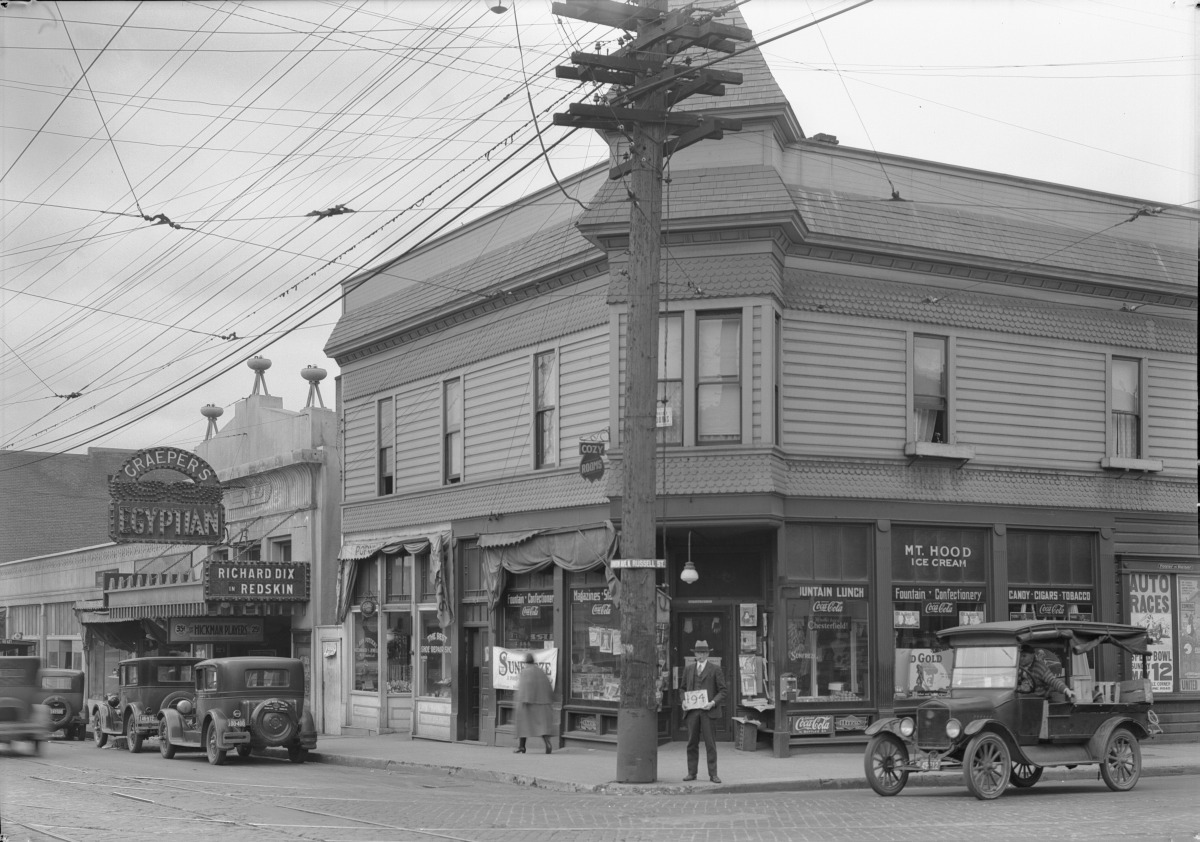
As Albina grew Union Avenue became a prominent business district. Notice the Egyptian Theatre to the left in this 1930’s picture.
Martin Mayo Building Then and Now

Martin Mayo Building 1930’s

The Martin Mayo Building, 2401 NE Union, is on the corner of Union (MLK) and Sacramento. It was built in 1912.
John F Wilson – Builder of Quality Homes in Eliot

In our neighborhood full of wonderful old homes, we often wonder who the actual builder was that put his design and energy into these buildings. Many of the skilled men who actually built our homes also lived inside Eliot. Some of them were masters at the design as well as the carpentry. John F. Wilson was one of these men who left their building legacy behind for us. But unlike most builders of the day, he remained inside our neighborhood for six more decades even though he switched residence in several houses.
Continue reading John F Wilson – Builder of Quality Homes in Eliot
Hill Block Then and Now

Hill Block 1910

The Hill Block Building was built by Charles H. Hill, Albina’s first mayor. Located at the corner of Russell and Williams it was at the center of the business district for Albina.
Neighborhood History Book in the Works

Roy E. Roos, author of many neighborhood history articles over the last 9 years, is putting together a book on the history of Albina. The old town of Albina was inside today’s Eliot, Boise & King neighborhoods. There has only been a limited amount of history documented about the early days of Albina and there have only been a few old photographs found at the Oregon Historic Society. He previously authored the book “The History & Development of Portland’s Irvington Neighborhood” in 1997 and is targeting publishing his latest book in 2007.
Thomas Lamb Eliot

The former Eliot school, now the Matt Dishman Center , was named after Thomas Lamb Eliot. Like many Portland neighborhoods, Eliot neighborhood was named after the school.
The following is a history of Thomas Lamb Eliot from the The Harvard Square Library website.
Eliot – The Making of a Neighborhood

Written by Carol Kennedy
April 1998
The Eliot neighborhood, located in northeast Portland, Oregon, is locally significant as the original town site, of the City of Albina. Of the many communities that ultimately merged to form the present City of Portland, the City of Albina occupies a distinct niche in the city’s history. No other township contributed as greatly as did Albina to defining Portland’s present-day boundaries. The union of the City of Albina and the City of Portland in 1891 also added to the City of Portland’s sociocultural history by later fostering a diverse working class, immigrant, and minority community.(1)
Historic Hibernian Hall

Today’s Wonder Ballroom was built by The Ancient Order of Hibernians, a group committed to immigration reform, civil rights for those of Irish descent and the preservation of the old Irish culture. Designed by the architecture firm of Jacobberger & Smith, the hall was completed on schedule and the first meeting was held in the new building on September 10, 1914.
The City of Albina and the Eliot Neighborhood
The following is an excerpt from Portland’s Adopted Eliot Neighborhood Plan 1993 pages 9 – 11.
The following discussion is from several sources. “History of the Albina Community,” a document produced by the 1990 Comprehensive Planning Workshop graduate students at Portland State University (PSU) formed the basis for this discussion. The workshop is a core requirement in PSU’s Master of Urban Planning Program. The students have graciously allowed the Albina Community Plan staff to use their work product in this planning effort. The Portland Bureau of Planning published the entire history report in 1990. It is available to those interested by contacting the Bureau. An article on Thomas Lamb Eliot by Stew Rogers that appeared in the November 1991 issue of the newsletter of the Eliot Neighborhood Association provided another source. In addition, a paper by Susan G. Hartnett “From Albina to Eliot: The Transformation of a 1887 City to 1991 Inner City Neighborhood” provided additional valuable information incorporated here.
Continue reading The City of Albina and the Eliot Neighborhood
The History of the Church at Ivy and Rodney

Like the Eliot Neighborhood in general the church at the corner of Ivy Street and Rodney Avenue has a long and rich history.
In 1890 the Trinity German Evangelical Lutheran Church of Albina was founded by the German missionary Reverend Edward Doering. The first church building, including a school in the daylight basement, was on the corner of Williams and San Antonio (now NE Graham St) in 1892.
Continue reading The History of the Church at Ivy and Rodney
 Eliot Neighborhood